
Warning signs detected
Official Google Firebase domain heavily abused by scammers for fake pharmacy and phishing links. Several risk indicators suggest caution. This site might be legitimate — but treat it as unverified until you can independently confirm.
Is page.link legit or a scam?
Be careful — we couldn't verify this site.
Official Google Firebase domain heavily abused by scammers for fake pharmacy and phishing links.
Score breakdown
 See the live page ↓
These checks passed — but they don't clear the site. A clean antivirus result, valid SSL, and a calm server only mean it isn't hosting malware; they say nothing about whether the business is real. This verdict is based on the site's conduct and content, not a malware detection.
Analysis Summary
Website Preview
Automated page render — captured in a safe sandbox. What an ordinary visitor would see when loading the site. Marker positions are approximate. See full visual analysis →
Visual analysis
We capture a fresh screenshot of the live page and ask a vision model to look for scam visual patterns — fake trust badges, countdown timers, overlay pop-ups, and visual clones of legitimate brands.
Visual red flags detected in the screenshot
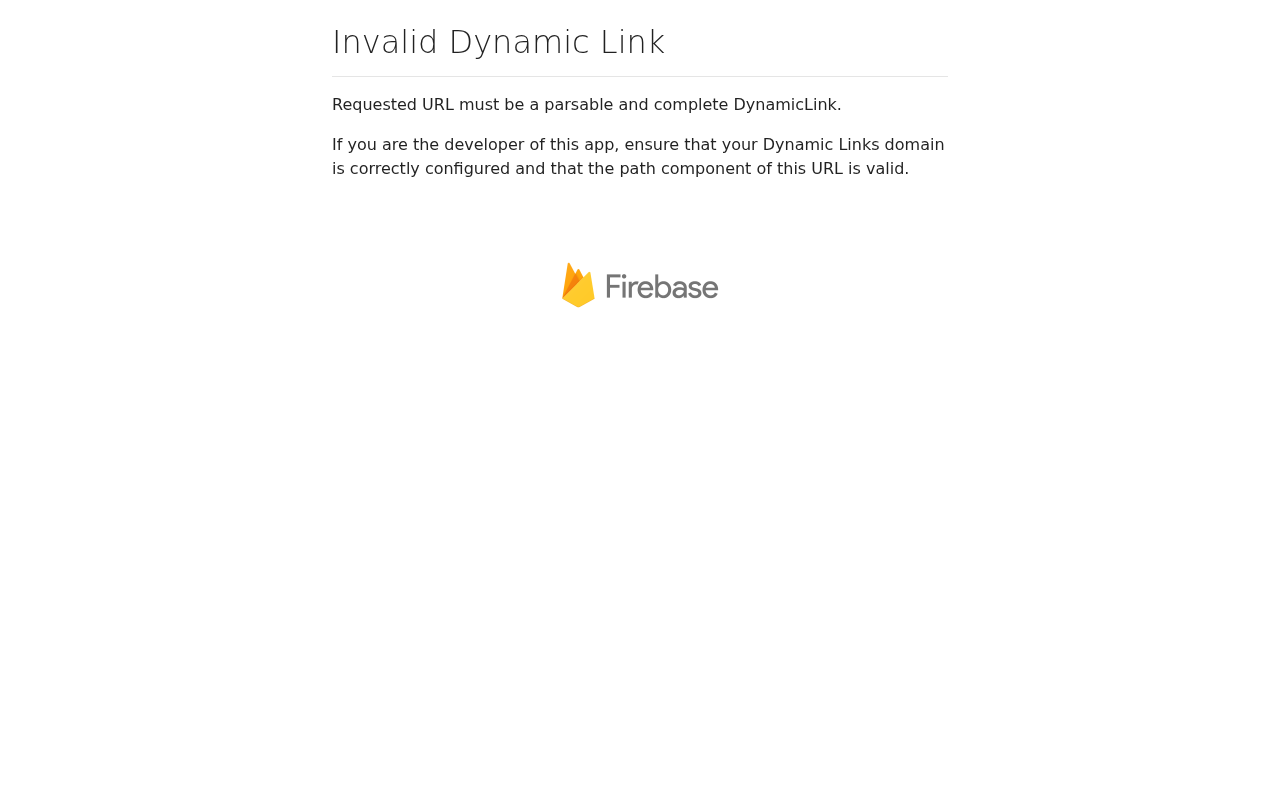
The page displays a standard Firebase Dynamic Links error message indicating a configuration issue or a broken link; it contains no functional content or scam indicators.
What our vision model saw
3 signalsPage appears parked or non-functional
Displays a technical error message regarding an Invalid Dynamic Link
Contains official Firebase branding for a configuration error
Intelligence
The domain itself is a legitimate Google-owned service that has been active for over nine years. Our antivirus network and browser blocklists returned clean results with no direct malware detections. However, the evidence package shows repeated abuse of page.link subdomains by fraudsters running fake pharmacy campaigns and phishing operations. Netcraft documented a twelve-month spike in such activity, and platforms like Facebook have blacklisted the domain due to spam volume. The current page shows a configuration error rather than active malicious content, but the infrastructure's history of misuse creates ongoing risk for visitors who click shortened links.
Web Research Findings
Our live research agent queries scam-report databases, consumer-review sites, news coverage, and general web search for page.link, then cross-checks business-registration records and look-alike domain patterns. Everything below is pulled from what it actually found.
- The domain page.link is an official Google-owned domain used for Firebase Dynamic Links (FDL).
- Google officially deprecated the Firebase Dynamic Links service on August 25, 2025, and links began returning 404 errors in 2026.
- Security researchers (Netcraft) have documented extensive abuse of page.link subdomains by 'fake pharmacy' scammers to bypass filters.
- The domain has historically been blacklisted or restricted by platforms like Facebook due to high volumes of spam and phishing links generated by users.
- Because it is a public-facing link shortener service, any individual can create a subdomain (e.g., 'yourbrand.page.link'), leading to frequent impersonation scams.
- Netcraftopen
"Netcraft analysts have observed evidence of a 12-month spike in fake pharmacy campaigns using page.link (Firebase Dynamic Links), more than doubling since last year."
- Reddit (r/phishing)open
"The link directed to a post from their page to look more legit, on which there is a actual scam link. This is their profile/page link: [subdomain].page.link. You can safely ignore/block/report."
- Stack Overflowopen
"My DLs [Dynamic Links] become blacklisted on Facebook and automatically deleted... Facebook is not able to show the preview metadata... *.page.link domain [banned]."
Owned and operated by Google as part of the Firebase platform.
Our research found three scam reports referencing page.link. Netcraft documented a twelve-month spike in fake pharmacy campaigns using Firebase Dynamic Links to evade detection. Reddit users described scammers posting page.link URLs that led to further malicious links. Stack Overflow threads noted that Facebook has blacklisted the domain due to high volumes of spam and phishing links. No positive reviews or trust signals were found in the evidence package.
Domain Timeline
- Feb 9, 2017Domain registered
First appeared in WHOIS records — 9.4 years old today.
- Jul 12, 2026Latest security review — Flagged as suspicious
This scan re-ran every check; the current findings are detailed above.
page.link is an established domain now carrying threat signals. An older domain that starts tripping security checks is a classic pattern for an asset that was sold, repurposed, or compromised — the age alone is not reassurance.
Threat Detection
Antivirus Engines
Security Scans
Checked against the major public blocklists used by browsers and security tools — no hits.
Reputation Sources
How this domain rates across independent threat-intelligence and blocklist providers.
Technical Details
domain · encryption · redirects · server reputation · referencedThe plumbing behind the site — who registered it, how it’s encrypted, where it’s hosted, and where it links out. A valid certificate or a calm server doesn’t mean the business is honest — scam sites pass these checks too. Use this to corroborate the verdict, not to overturn it.
Domain & Encryption
Redirect Chain
- 1301http://page.link/
- 2400https://page.link/
Server Reputation
What to do
Proceed with caution
Our automated review flagged enough risk that you should treat this site as unverified.
- Treat page.link as unverified
Do not enter credentials or send money until you have independently verified the business.
- Verify the business through independent channels
Check the company's social profiles, registry records, and search for recent news or reviews that are not hosted on the site itself.
- Never use irreversible payment methods
Crypto, gift cards, wire transfers, and cash apps offer zero buyer protection. Use a credit card or PayPal if you must pay.
- OpenShare your experience
If you have additional context, drop a comment below or post on the MalwareTips forum.
Final Verdict
page.link is Google's official Firebase Dynamic Links domain. Scammers frequently abuse subdomains to host fake pharmacy and phishing links, which has led to platform restrictions and documented abuse campaigns.
Safety FAQ
Common questions, answered directly from the scan data above — so the answers always reflect the latest verdict on this page.
- page.link looks like a likely scam site — avoid interacting with it. The domain is 9.4 years old through MarkMonitor Inc.. It may not be an outright scam, but the risk is high enough that you should verify it independently before trusting it with money or data.
- Proceed with caution — page.link scores 55/100 on our trust scale. We found enough warning signals to recommend verifying it through independent channels before entering credentials or money.
- If you've already paid or handed over details on page.link, act quickly. 1) Contact your bank or card issuer immediately and ask to dispute the charge or open a chargeback — the sooner you act, the better your odds. 2) Report the site to the U.S. FTC at reportfraud.ftc.gov or the FBI's IC3 at ic3.gov, and in the UK to Action Fraud at actionfraud.police.uk. 3) If you entered a password, change it on page.link and anywhere you reused it, and turn on two-factor authentication. 4) Watch your bank and email for follow-up fraud, and keep screenshots as evidence.
- Often yes, if you act fast. Payments made by credit or debit card can frequently be reversed through a chargeback or dispute — contact your bank right away and explain it was a fraudulent site. Bank transfers and gift-card or voucher payments are much harder to recover, but you should still report them to your bank and to the FTC (reportfraud.ftc.gov) or Action Fraud (actionfraud.police.uk). Avoid any "refund" or "recovery" service that contacts you first — it's usually a follow-up scam.
- Just viewing a scam page is usually low-risk on an up-to-date browser — the real danger is what it asks you to DO (enter details, download a file, send money). If you downloaded anything, run a full antivirus scan and treat the file as untrusted. If you entered a password or card number, change the password everywhere you reused it and contact your bank.
- You can report page.link through several official channels: the U.S. FTC at reportfraud.ftc.gov, the FBI's Internet Crime Complaint Center (IC3) at ic3.gov, and — in the UK — Action Fraud at actionfraud.police.uk. You can also flag it to Google Safe Browsing (safebrowsing.google.com/safebrowsing/report_phish) so other browsers warn about it, and report it to the company being impersonated if there is one. Reporting helps get scam sites taken down faster.
- Modern scams are built to look convincing. A valid SSL padlock, a polished template, stock photos, fake reviews, and a trust badge can all be added in minutes and prove nothing about who runs the site. Scammers buy cheap domains, clone real designs, and copy legal pages wholesale. That's exactly why an automated review that checks the domain's age, hosting, blacklists, and behaviour — rather than just how the page looks — is more reliable than a first impression.
- No — all 92 antivirus and blocklist engines in our malware network currently report page.link as clean. That's a good sign, though antivirus coverage is only one of the many signals we weigh, and brand-new scam sites can appear clean before vendors catch up.
- No — page.link is not currently on the major browser blocklist feeds that Chrome, Safari, Firefox, and Edge rely on. Note that blocklists can lag behind brand-new scam domains, so "not listed" is reassuring but not a guarantee on its own.
- page.link is 9.4 years old, registered on February 9, 2017 through MarkMonitor Inc.. A multi-year registration history is one of the stronger signals against a scam, though it's never a guarantee on its own — established domains can still be misused.
- Yes — page.link presents a valid TLSv1.3 certificate issued by Google Trust Services · WR2, valid for another 63 days. Important caveat: SSL only encrypts the connection between you and the site — it does not verify who runs it. Almost all scam sites now have valid SSL too, so a padlock alone never means "safe".
- page.link resolves to an IP operated by Google LLC in US (Content Delivery Network). Hosting location alone doesn't make a site good or bad — but hosting that doesn't match a brand's claimed country, or that sits on networks known for abuse, is one of the many signals we weigh alongside the verdict above.
User reviews & comments(0)
Share your experience — "Lost $200 on a fake checkout" is more useful than "Scam". Your review helps others avoid traps.