
No threats detected
All checks passed. This site appears legitimate — but always stay alert for phishing even on trusted domains.
Is udel.edu legit or a scam?
Official University of Delaware homepage with clean security signals and long-standing institutional accreditation.
Analysis Summary
Website Preview
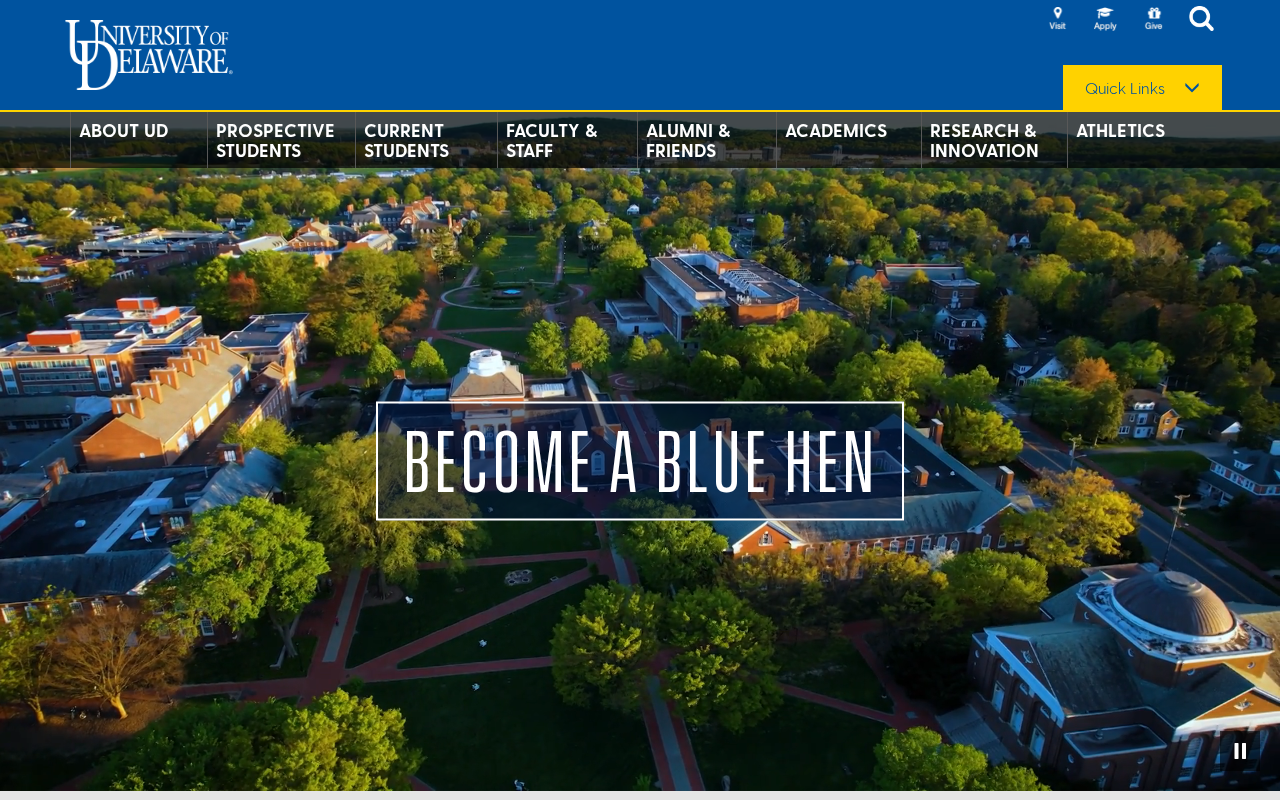
Automated page render — captured in a safe sandbox. What an ordinary visitor would see when loading the site. See full visual analysis →
Visual analysis
We capture a fresh screenshot of the live page and ask a vision model to look for scam visual patterns — fake trust badges, countdown timers, overlay pop-ups, and visual clones of legitimate brands.
No scam visual patterns detected
The screenshot displays a professional and fully-rendered homepage for the University of Delaware with no visual indicators of scam or malicious intent.
What our vision model saw
6 signalsProfessional high-resolution aerial photography of a university campus
Official University of Delaware branding and logo in the header
Standard academic navigation menu including 'Prospective Students' and 'Academics'
Functional UI elements such as a 'Quick Links' dropdown and search icon
Presence of 'Visit', 'Apply', and 'Give' call-to-action buttons consistent with higher education sites
No visible urgency tactics, fake trust badges, or suspicious pop-ups
Intelligence
The domain udel.edu matches the known official site of a public research university founded in 1743. Our antivirus network returned zero detections across 92 engines and the hosting IP shows no abuse history. The page displays standard university navigation, professional campus photography, and legitimate external links to social platforms and analytics services. Business registration confirms active status as a state-assisted land-grant institution accredited since 1921. While phishing emails have impersonated the university in the past, those attacks target users rather than originate from this domain. The combination of age, accreditation, clean infrastructure, and positive academic rankings supports a high-trust assessment.
Web Research Findings
Our live research agent queries scam-report databases, consumer-review sites, news coverage, and general web search for udel.edu, then cross-checks business-registration records and look-alike domain patterns. Everything below is pulled from what it actually found.
- Domain udel.edu is the official website of the University of Delaware, a public research university founded in 1743 (chartered 1769) in Newark, Delaware.
- Accredited by Middle States Commission on Higher Education (MSCHE); accreditation reaffirmed March 10, 2022, next review 2028-2029.
- University maintains dedicated pages and alerts for reporting phishing and scams targeting students/faculty (e.g., reportaphish@udel.edu).
- Multiple Reddit posts and university alerts document phishing emails impersonating UD services, but these target the university community rather than originating from udel.edu.
- Ranked highly in national lists: #43 top public school (U.S. News), #26 overall (WSJ/College Pulse); positive student reviews on Niche (A grade) and Princeton Review.
- No scam reports, fraud complaints, or negative business registrations found for the official domain or institution.
- Wikipedia and official history confirm long-standing legitimate educational institution with ~24,000 students and multiple campuses.
- Reddit r/udelopen
"Yes, this is a scam . I got a nearly identical message as a Drexel University (Philadelphia) student. I assume this is some coordinated scam ..."
- WHYYopen
"Email scam targets Univ. of Delaware faculty - The school warns any faculty that may have input their credentials into a bogus site to change the password on their UDelNet login immediately."
- Secure UD Threat Alertsopen
"Email claiming you've exceeded UDel email quota is a phishing scam - This scam is addressed to “Dear UDEL.EDU Account User” — if YOUR account has exceeded its quota , why wouldn't the email address you by name?"
Public research university, state-assisted, land-grant institution in Delaware; accredited by Middle States Commission on Higher Education (MSCHE) since 1921, reaffirmed March 10, 2022.
Our research located three mentions of phishing emails that impersonate University of Delaware services, reported on Reddit and local news outlets. Two additional sources confirm positive institutional reputation through national rankings and student reviews on Niche. No scam reports or fraud complaints were found against the official udel.edu domain itself.
Threat Detection
Antivirus Engines
Security Scans
Checked against the major public blocklists used by browsers and security tools — no hits.
Reputation Sources
How this domain rates across independent threat-intelligence and blocklist providers.
Technical Details
domain · encryption · redirects · server reputation · referencedContact Verification
We fetched the page and looked for real-world contact details. Legitimate businesses almost always publish an email on their own domain, a phone number, and a postal address. Scam shops usually don't.
- No contact email found anywhere on the page.
- No phone number listed on the page.
- No postal address visible on the page.
- Links to 10 social profiles.
Domain & Encryption
Redirect Chain
- 1301http://udel.edu/
- 2302https://udel.edu/
- 3200https://www.udel.edu/
Server Reputation
Referenced Domains
Outbound domains this page links to or loads resources from. Each links to its own security scan.
What to do
Still, stay alert
No major threat indicators — but a clean scan does not guarantee every page is safe, and phishing emails routinely spoof real domains.
- Double-check the exact URL in your address bar
Confirm you are actually on udel.edu and not a lookalike like u-del.edu.com or an IDN homoglyph.
- Use a password manager
Password managers only auto-fill on the exact domain they were saved for — they refuse to fill lookalike domains, which is the single best phishing defence.
- OpenDiscuss this site on the forum
If you have first-hand experience with this site — good or bad — share it with the MalwareTips community.
Final Verdict
This is the official homepage of the University of Delaware. The domain carries a clean scan record, valid SSL certificate, and established institutional registration. No payment or login forms appear on the page.
Safety FAQ
Common questions about this site, answered directly from the scan data above — so the answers always reflect the latest verdict on this page.
- Our automated security review found no threat indicators on udel.edu. The site appears legitimate based on the signals we checked, but always stay alert for phishing emails that spoof real domains.
- udel.edu passed our automated security checks with a trust score of 97/100. No antivirus engines or major blacklists flagged the site at the time of the last scan.
- Yes. udel.edu presents a valid TLSv1.3 certificate issued by GlobalSign nv-sa · GlobalSign RSA OV SSL CA 2018, expiring in 73 days. Note that SSL only encrypts the connection — it does not guarantee that the site itself is trustworthy.
- No. All 92 antivirus engines in our malware network report udel.edu as clean.
- No. udel.edu is not currently listed on the major browser blocklist feeds that modern browsers use.
- udel.edu resolves to an IP operated by University of Delaware in US (usage type: University/College/School). Hosting location alone doesn't make a site good or bad, but unusual geography for a brand's claimed country is one of many signals we weigh.
- Yes. udel.edu sits in the global top-100k on Cloudflare Radar, which means it has substantial real-world traffic. That does not automatically make it safe, but established brands almost always rank here and throwaway scam domains almost never do.
- This is a permanent record of the scan run on July 8, 2026. The verdict and evidence above reflect that scan and do not change on their own. If circumstances around udel.edu have changed, MalwareTips staff can run a fresh scan, which re-runs every check from scratch and publishes an updated report.
User reviews & comments(0)
Share your experience — "Lost $200 on a fake checkout" is more useful than "Scam". Your review helps others avoid traps.