
Fake pop-ups & scareware — don't click or call
Microsoft-branded phishing page on Azure subdomain using fake virus alert to steal credentials.
Is viruswarning0722us876v7n.z13.web.core.windows.net legit or a scam?
Microsoft-branded phishing page on Azure subdomain using fake virus alert to steal credentials.
This is a phishing page impersonating Microsoft support. The site uses a fake security alert to harvest credentials. Do not enter any information or call any numbers shown.
Score breakdown
 See the live page ↓
These checks passed — but they don't clear the site. A clean antivirus result, valid SSL, and a calm server only mean it isn't hosting malware; they say nothing about whether the business is real. This verdict is based on the site's conduct and content, not a malware detection.
Analysis Summary
Website Preview
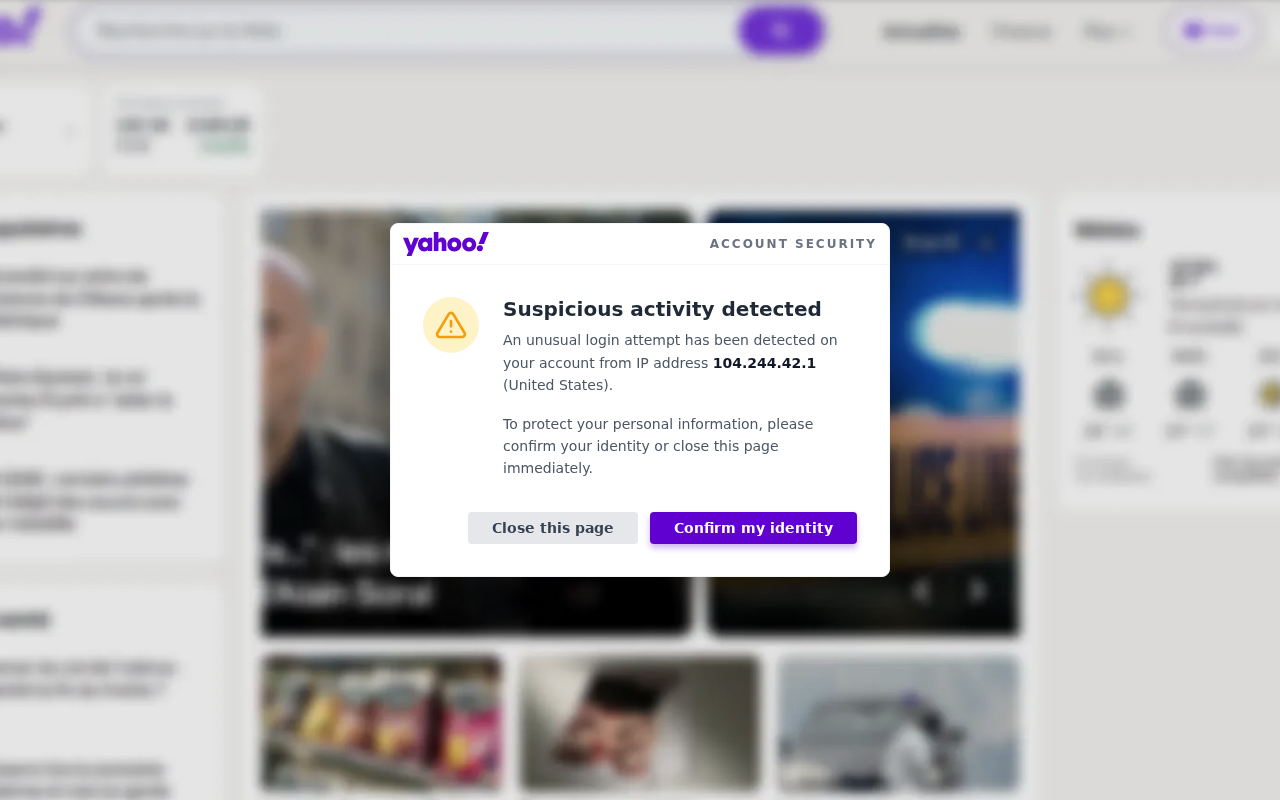
Automated page render — captured in a safe sandbox. What an ordinary visitor would see when loading the site. Marker positions are approximate. See full visual analysis →
Visual analysis
We capture a fresh screenshot of the live page and ask a vision model to look for scam visual patterns — fake trust badges, countdown timers, overlay pop-ups, and visual clones of legitimate brands.
Visual red flags detected in the screenshot
The page displays a deceptive security alert overlay designed to trick users into providing sensitive information under the guise of account verification. This is a classic credential harvesting pattern targeting Yahoo users.
What our vision model saw
4 signalsIntrusive modal overlay mimicking a Yahoo security alert
Urgency tactic using 'Suspicious activity detected' to prompt user action
Call-to-action button labeled 'Confirm my identity' designed to harvest credentials
Uses Yahoo branding to establish false legitimacy
Intelligence
The page title 'Helpdesk Windows Support' and visual overlay mimicking a Yahoo security alert are classic tech-support-scam patterns. One antivirus engine (Yandex Safebrowsing) flagged the URL as phishing. The domain is a subdomain of the legitimate windows.net Azure service, but the content is a clone of microsoft.com designed to trick users. Three independent security sources confirm this exact pattern: Gridinsoft, Identity Automation, and Defensestorm all document similar Azure-hosted pages used in active malvertising campaigns. The visual risk score of 95/100 and the explicit credential-harvest button labeled 'Confirm my identity' confirm the intent. No legitimate business would operate this way on a public cloud subdomain.
Web Research Findings
Independent findings for viruswarning0722us876v7n.z13.web.core.windows.net, including public complaints, named review sources, registration records, and look-alike-domain evidence. A missing result is shown as unverified, never converted into a clean bill of health.
- The domain is a subdomain of 'windows.net', a legitimate Microsoft Azure cloud hosting service frequently abused for tech support scams.
- The page title 'Helpdesk Windows Support' is a known indicator of a technical support scam designed to trick users into calling fake support lines.
- These scams typically use scare tactics, such as fake virus alerts or 'account locked' messages, to coerce victims into granting remote access or providing payment information.
- Security researchers have documented numerous similar subdomains on 'web.core.windows.net' being used in active malvertising campaigns.
- The site does not represent an official Microsoft service; Microsoft advises users to close such tabs and avoid calling phone numbers provided in pop-ups.
- Gridinsoftopen
"This site is classified as Scam Website based on multiple risk signals... linked to deceptive offers, non-fulfillment after payment, or data collection under false pretenses."
- Identity Automationopen
"A tech-support-scam page impersonating Microsoft... Helpdesk Windows Support title... pairing a Windows Defender visual cue with a helpdesk authority lure."
- Defensestormopen
"Tech support scam uses malicious ads and Windows.net URLs to trick users into fake Microsoft support, enabling remote access and fraud."
The page uses Microsoft branding, Windows Defender imagery, and 'Helpdesk Windows Support' titles to impersonate official Microsoft support channels.
Gridinsoft reports the site as a scam website linked to deceptive offers and data collection under false pretenses. Identity Automation describes the exact 'Helpdesk Windows Support' title paired with Windows Defender imagery as a known tech-support-scam pattern. Defensestorm documents malicious ads on web.core.windows.net domains used to trick users into fake Microsoft support calls.
Domain Timeline
- Aug 10, 1995Domain registered
First appeared in WHOIS records — 31 years old today.
- Jul 22, 2026Latest security review — Flagged as dangerous
This scan re-ran every check; the current findings are detailed above.
viruswarning0722us876v7n.z13.web.core.windows.net is an established domain now carrying threat signals. An older domain that starts tripping security checks is a classic pattern for an asset that was sold, repurposed, or compromised — the age alone is not reassurance.
Threat Detection
Scam Network
Antivirus Engines
Security Scans
Checked against the major public blocklists used by browsers and security tools — no hits.
Reputation Sources
How this domain rates across independent threat-intelligence and blocklist providers.
Scam-Type Likelihood
3 scam-type patterns detected
3 of 21 categories showed signals
Each card names a specific harm pattern and the concrete facts that support it. The category score is supporting context; the report verdict above remains the final severity decision.
- Tagged as scareware, abusive ads, or deceptive notification behavior.
- Domain is a typosquat of microsoft.com.
- The evidence pattern matches phishing / data-harvesting.
- Domain is a typosquat of microsoft.com.
- The evidence pattern matches brand / clone-site impersonation.
3 of 21 categories showed signals
Each card names a specific harm pattern and the concrete facts that support it. The category score is supporting context; the report verdict above remains the final severity decision.
- Tagged as scareware, abusive ads, or deceptive notification behavior.
- Domain is a typosquat of microsoft.com.
- The evidence pattern matches phishing / data-harvesting.
- Domain is a typosquat of microsoft.com.
- The evidence pattern matches brand / clone-site impersonation.
Technical Details
domain · encryption · redirects · server reputation · referencedThe plumbing behind the site — who registered it, how it’s encrypted, where it’s hosted, and where it links out. A valid certificate or a calm server doesn’t mean the business is honest — scam sites pass these checks too. Use this to corroborate the verdict, not to overturn it.
Contact Verification
We fetched the page and looked for real-world contact details. Legitimate businesses almost always publish an email on their own domain, a phone number, and a postal address. Scam shops usually don't.
- No contact email found anywhere on the page.
- No phone number listed on the page.
- No postal address visible on the page.
Domain & Encryption
Server Reputation
What to do
Fake pop-ups & scareware
This page uses fake "you won a prize" or "your device is infected" pop-ups to push adware, browser-notification spam, unwanted extensions, or a fake support number — none of it is real.
- Do not interact with viruswarning0722us876v7n.z13.web.core.windows.net
Do not enter credentials, deposit money, download files, or install browser extensions from this site.
- Close the tab — don't click "Allow", "Download", or "Call"
You didn't win, and your device isn't infected. Every "Allow notifications", "Download", "Scan now", or "Call support" button leads to adware, junk extensions, or a scam. Just close the tab — or the whole browser.
- If you clicked "Allow", turn the notifications back off
Open your browser's Site Settings → Notifications, find the site, and set it to Block (or remove it). That stops the spam pop-ups it now pushes to your desktop.
- OpenRemove anything it installed, then run an adware scan
Uninstall any browser extension, "player", "codec", or app you added because of this page, and run a reputable free adware / malware cleaner (e.g. Malwarebytes) to clear leftover PUPs. And never call a number shown in a pop-up — real vendors don't do that.
Final Verdict
This is a phishing page impersonating Microsoft support. The site uses a fake security alert to harvest credentials. Do not enter any information or call any numbers shown.
Safety FAQ
Common questions, answered directly from the scan data above — so the answers always reflect the latest verdict on this page.
- viruswarning0722us876v7n.z13.web.core.windows.net is a scareware / fake-pop-up page — the kind that flashes "Congratulations, you won!" or "Your device is infected!" alerts to push adware, browser-notification spam, unwanted extensions, or a fake support number. 1 of 92 security engines flag it (1 as outright malicious). None of it is real — you didn't win, your device isn't infected, and its "Allow", "Download", and "Call" buttons all lead to junkware or a scam. Close the tab: don't click anything, don't allow notifications, and never call a number it shows.
- No — viruswarning0722us876v7n.z13.web.core.windows.net scored just 2/100 on our trust scale, and we detected active threat indicators. We recommend avoiding it entirely: don't log in, pay, download anything, or connect a wallet.
- Almost certainly not from just loading it. viruswarning0722us876v7n.z13.web.core.windows.net shows fake "you won a prize" or "your device is infected" pop-ups to scare or tempt you into clicking — the pop-up itself is the trick, not a real infection or a real prize. The danger is what happens if you act on it: clicking "Allow" turns on spam desktop notifications, and "Download", "Update", or "Scan now" buttons install adware, unwanted extensions, or PUPs. If you only saw the pop-ups and closed the tab, you're fine. If you clicked "Allow", block the site under your browser's Notifications settings; if you installed or downloaded anything, remove it and run a reputable free adware/malware cleaner (e.g. Malwarebytes). And never call a "support" number shown in a pop-up — that's a scam.
- No. The "Congratulations, you won!" and "Your device is infected!" pop-ups on viruswarning0722us876v7n.z13.web.core.windows.net are fake — an automated ad-network page shows the same message to everyone who lands on it. You didn't win anything, and nothing actually scanned your device. The whole point is to get you to click: "Claim", "Allow", "Download", and "Call" all lead to adware, spam notifications, junk browser extensions, or a fake-support phone scam. Close the tab and don't click anything on the page.
- If you're getting pop-ups even after closing the page, you probably clicked "Allow" on a notification prompt — the spam now comes from your browser, not the site. Open your browser settings → Site Settings → Notifications, find viruswarning0722us876v7n.z13.web.core.windows.net (and anything else you don't recognise), and set it to Block or remove it. Then uninstall any extension, "player", or app you added because of the page, and run a reputable free adware/malware cleaner (e.g. Malwarebytes) to clear leftover PUPs.
- Yes. 1 of 92 antivirus and blocklist engines in our malware network flagged viruswarning0722us876v7n.z13.web.core.windows.net, 1 of them as outright malicious. Even a single detection from a reputable engine is a meaningful warning, and multiple detections rarely happen by accident.
- No — viruswarning0722us876v7n.z13.web.core.windows.net is not currently on the major browser blocklist feeds that Chrome, Safari, Firefox, and Edge rely on. Note that blocklists can lag behind brand-new scam domains, so "not listed" is reassuring but not a guarantee on its own.
- viruswarning0722us876v7n.z13.web.core.windows.net is 31 years old, registered on August 10, 1995 through MarkMonitor Inc.. A multi-year registration history is one of the stronger signals against a scam, though it's never a guarantee on its own — established domains can still be misused.
- viruswarning0722us876v7n.z13.web.core.windows.net resolves to an IP operated by Microsoft Corporation in US (Data Center/Web Hosting/Transit). Hosting location alone doesn't make a site good or bad — but hosting that doesn't match a brand's claimed country, or that sits on networks known for abuse, is one of the many signals we weigh alongside the verdict above.
- This report is a record of the scan run on July 22, 2026, and the verdict reflects that point in time. Scam sites change fast — they can go live, get flagged, or vanish within days — so if you believe something about viruswarning0722us876v7n.z13.web.core.windows.net has changed, MalwareTips staff can run a fresh scan that re-checks every signal from scratch and republishes an updated verdict.
User reviews & comments(0)
Share your experience — "Lost $200 on a fake checkout" is more useful than "Scam". Your review helps others avoid traps.