
Unlicensed casino / gambling warning signs
29-year-old typosquat of whitehouse.gov now operating an unlicensed election betting site with free-play-money lures. This looks like an unlicensed crypto-casino / betting site. Treat any deposit as a total-loss risk and verify the operator's gambling licence before you sign up.
Is whitehouse.com legit or a scam?
Be careful — we couldn't verify this site.
29-year-old typosquat of whitehouse.gov now operating an unlicensed election betting site with free-play-money lures.
Score breakdown
 See the live page ↓
These checks passed — but they don't clear the site. A clean antivirus result, valid SSL, and a calm server only mean it isn't hosting malware; they say nothing about whether the business is real. This verdict is based on the site's conduct and content, not a malware detection.
Analysis Summary
Website Preview
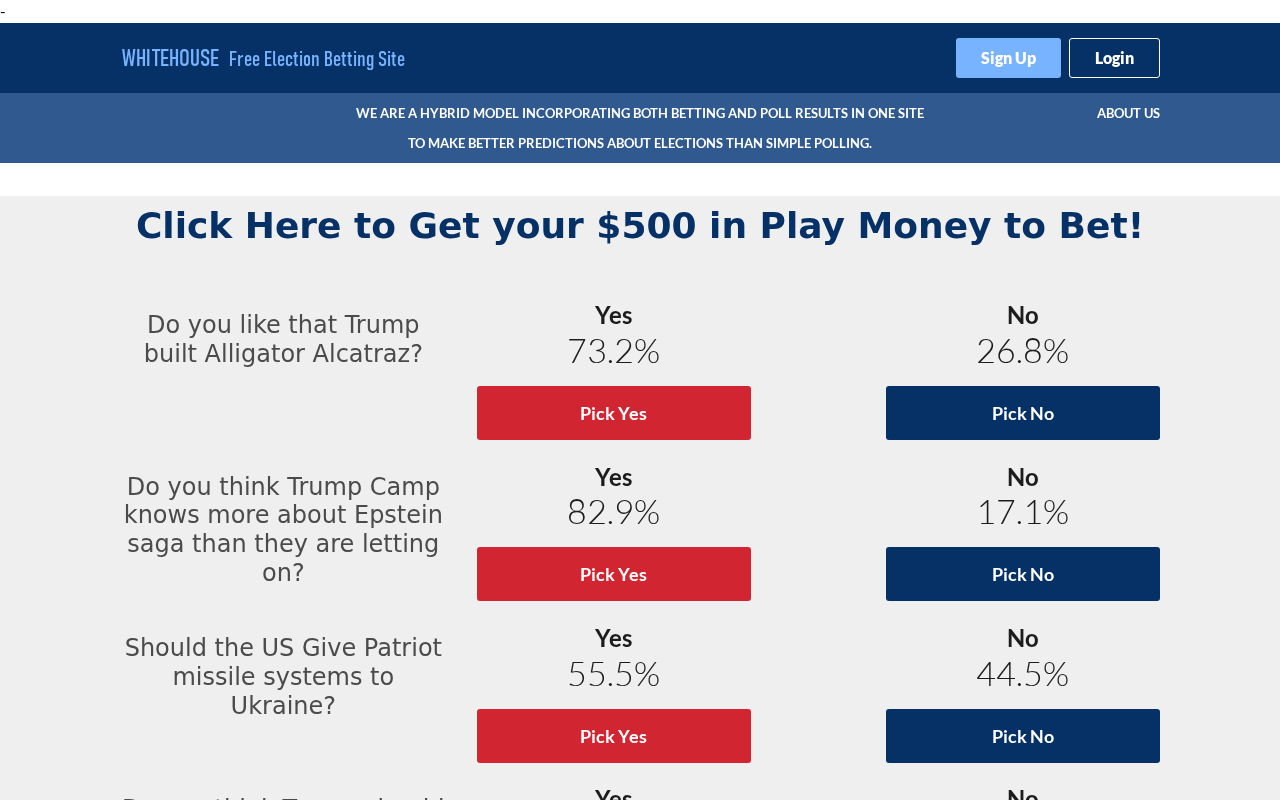
Automated page render — captured in a safe sandbox. What an ordinary visitor would see when loading the site. Marker positions are approximate. See full visual analysis →
Visual analysis
We capture a fresh screenshot of the live page and ask a vision model to look for scam visual patterns — fake trust badges, countdown timers, overlay pop-ups, and visual clones of legitimate brands.
Visual red flags detected in the screenshot
The site uses inflammatory political content and financial incentives to lure users into a betting-style interface, while misappropriating the 'WHITEHOUSE' name to establish false authority.
What our vision model saw
4 signalsHigh-pressure financial incentive offered as 'free play money' to encourage user interaction
Unprofessional and inflammatory content regarding political figures and sensitive topics
Use of the 'WHITEHOUSE' name to imply official government endorsement or affiliation
Layout mimics a betting platform interface to solicit user engagement with speculative content
Intelligence
The domain itself is old and has a documented history of commercial exploitation of the whitehouse.gov name. Current content pushes a betting interface that offers $500 in play money and asks users to create accounts. Gridinsoft flagged the site as suspicious and described it as a low-trust casino with unconfirmed licensing. The page carries a disclaimer denying government affiliation, yet the branding and political poll questions create a misleading impression of authority. No phone, email, or business registration details are visible on the site itself. The combination of historical typosquatting, gambling mechanics, and missing contact information places the site in the suspicious category.
Web Research Findings
Our live research agent queries scam-report databases, consumer-review sites, news coverage, and general web search for whitehouse.com, then cross-checks business-registration records and look-alike domain patterns. Everything below is pulled from what it actually found.
- Whitehouse.com is a well-documented historical example of typosquatting, originally registered in 1997 to capitalize on users mistyping the official U.S. government domain (whitehouse.gov).
- The site has undergone numerous rebrandings over nearly three decades, including periods as an adult entertainment site, a real estate portal, a political commentary forum, and a video hosting site.
- As of recent reports, the site functions as a political election betting and polling platform.
- Security researchers and safety tools have flagged the site as a 'low-trust' entity, particularly regarding its current betting operations and lack of transparent licensing.
- The site includes a disclaimer stating it is not affiliated with or endorsed by the U.S. Government, a measure taken following legal pressure from the Clinton administration in the late 1990s.
- Gridinsoft
"Whitehouse.com is rated as a low-trust casino. This usually indicates limited operating history, weak reputation evidence, or licensing claims that cannot be independently confirmed."
The site claims to be owned and operated by WhiteHouse Network LLC, a company based in New Jersey.
The domain is a long-standing example of typosquatting/domain misuse, historically redirecting users intending to visit the official U.S. government site (whitehouse.gov) to adult content or other commercial ventures.
Our research located one report describing whitehouse.com as a low-trust casino with unconfirmed licensing. The report notes the site's limited operating history in its current form. No consumer complaints or positive reviews were found across the sources checked. The domain's history of typosquatting whitehouse.gov is well documented in public records.
Domain Timeline
- May 21, 1997Domain registered
First appeared in WHOIS records — 29 years old today.
- Jul 15, 2026Latest security review — Flagged as suspicious
This scan re-ran every check; the current findings are detailed above.
whitehouse.com is an established domain now carrying threat signals. An older domain that starts tripping security checks is a classic pattern for an asset that was sold, repurposed, or compromised — the age alone is not reassurance.
Threat Detection
Scam Network
Antivirus Engines
Security Scans
Checked against the major public blocklists used by browsers and security tools — no hits.
Reputation Sources
How this domain rates across independent threat-intelligence and blocklist providers.
Scam-Type Likelihood
1 scam-type patterns detected
1 of 21 categories showed signals
We check every URL against 21 distinct scam categories so the verdict tells you not just how risky the page is, but what kind of risk it carries. Each meter pulls from page signals, web reports, our AI analyst, vision, and the scam-network cluster — not from raw AV labels.
- AI analyst tagged this as a casino / gambling scam.
1 of 21 categories showed signals
We check every URL against 21 distinct scam categories so the verdict tells you not just how risky the page is, but what kind of risk it carries. Each meter pulls from page signals, web reports, our AI analyst, vision, and the scam-network cluster — not from raw AV labels.
- AI analyst tagged this as a casino / gambling scam.
Technical Details
domain · encryption · redirects · server reputation · referencedThe plumbing behind the site — who registered it, how it’s encrypted, where it’s hosted, and where it links out. A valid certificate or a calm server doesn’t mean the business is honest — scam sites pass these checks too. Use this to corroborate the verdict, not to overturn it.
Contact Verification
We fetched the page and looked for real-world contact details. Legitimate businesses almost always publish an email on their own domain, a phone number, and a postal address. Scam shops usually don't.
- No contact email found anywhere on the page.
- No phone number listed on the page.
- Postal address visible on the page.
Domain & Encryption
Redirect Chain
- 1302http://whitehouse.com/
- 2200https://www.whitehouse.com/
Server Reputation
Referenced Domains
Outbound domains this page links to or loads resources from. Each links to its own security scan.
What to do
Unlicensed casino / gambling warning signs
This looks like an unlicensed crypto-casino / betting site — the kind promoted through fake celebrity ads.
- Treat whitehouse.com as unverified
Do not enter credentials or send money until you have independently verified the business.
- Don't deposit, connect a wallet, or sign up
Unlicensed crypto casinos rig the games and freeze withdrawals — treat any crypto you deposit as gone. "Bonuses" exist to lock your money behind impossible wagering requirements.
- Check for a real gambling licence before trusting any casino
Legitimate casinos show a verifiable licence number (UKGC, MGA, or a state gaming board) you can confirm on the regulator's own website. No licence, or an unverifiable one, means no protection.
- OpenIf you already deposited, act fast
Crypto transfers are usually irreversible — report the wallet to the exchange you sent from and to IC3 (ic3.gov). Card deposits may be chargeback-eligible; contact your bank. Ignore any "recovery agent" who contacts you afterward — that's a second scam.
Final Verdict
Whitehouse.com runs a political election betting and polling platform. The domain is a 29-year-old typosquat of whitehouse.gov that has cycled through adult content, real estate, and commentary over decades. No contact details or verifiable licensing appear on the page.
Safety FAQ
Common questions, answered directly from the scan data above — so the answers always reflect the latest verdict on this page.
- whitehouse.com looks like a likely crypto casino / gambling scam — do not deposit funds or connect a wallet. Our review tagged it for gambling. 1 of 92 security engines flag it. The domain is 29.2 years old through Sea Wasp, LLC. It may not be an outright scam, but the risk is high enough that you should verify it independently before trusting it with money or data.
- Proceed with caution — whitehouse.com scores 47/100 on our trust scale. We found enough warning signals to recommend verifying it through independent channels before entering credentials or money.
- If you've already paid or handed over details on whitehouse.com, act quickly. 1) Cryptocurrency payments are almost always irreversible, so a bank chargeback usually won't apply — instead report the wallet address to the exchange you sent from and ask them to flag it. 2) Report the site to the U.S. FTC at reportfraud.ftc.gov or the FBI's IC3 at ic3.gov, and in the UK to Action Fraud at actionfraud.police.uk. 3) If you entered a password, change it on whitehouse.com and anywhere you reused it, and turn on two-factor authentication. 4) Watch your bank and email for follow-up fraud, and keep screenshots as evidence.
- Possibly, but it's difficult. Crypto transfers can't be reversed like card payments, so recovery usually depends on the receiving exchange freezing the funds — report the wallet address and transaction ID to that exchange and to IC3 (ic3.gov) as fast as you can. Be very wary of "recovery agents" who contact you promising to get your crypto back; that is almost always a second scam targeting victims.
- We found no evidence of a verifiable gambling licence for whitehouse.com, and it lists no real operator or company details. Legitimate casinos prominently display a licence number from a regulator (like the UKGC, MGA, or a state gaming board) that you can check on the regulator's own website. Unlicensed crypto-casino sites frequently let you deposit and even "win," then block or void withdrawals — so treat any winnings shown on screen as bait, not money you can actually take out.
- You can report whitehouse.com through several official channels: the U.S. FTC at reportfraud.ftc.gov, the FBI's Internet Crime Complaint Center (IC3) at ic3.gov, and — in the UK — Action Fraud at actionfraud.police.uk. You can also flag it to Google Safe Browsing (safebrowsing.google.com/safebrowsing/report_phish) so other browsers warn about it, and report it to the company being impersonated if there is one. Reporting helps get scam sites taken down faster.
- Modern scams are built to look convincing. A valid SSL padlock, a polished template, stock photos, fake reviews, and a trust badge can all be added in minutes and prove nothing about who runs the site. Scammers buy cheap domains, clone real designs, and copy legal pages wholesale. That's exactly why an automated review that checks the domain's age, hosting, blacklists, and behaviour — rather than just how the page looks — is more reliable than a first impression.
- Yes. 1 of 92 antivirus and blocklist engines in our malware network flagged whitehouse.com as suspicious. Even a single detection from a reputable engine is a meaningful warning, and multiple detections rarely happen by accident.
- No — whitehouse.com is not currently on the major browser blocklist feeds that Chrome, Safari, Firefox, and Edge rely on. Note that blocklists can lag behind brand-new scam domains, so "not listed" is reassuring but not a guarantee on its own.
- whitehouse.com is 29.2 years old, registered on May 21, 1997 through Sea Wasp, LLC. A multi-year registration history is one of the stronger signals against a scam, though it's never a guarantee on its own — established domains can still be misused.
- Yes — whitehouse.com presents a valid TLSv1.3 certificate issued by Let's Encrypt · YR2, valid for another 69 days. Important caveat: SSL only encrypts the connection between you and the site — it does not verify who runs it. Almost all scam sites now have valid SSL too, so a padlock alone never means "safe".
- whitehouse.com resolves to an IP operated by Amazon.com, Inc. in US (Data Center/Web Hosting/Transit). Hosting location alone doesn't make a site good or bad — but hosting that doesn't match a brand's claimed country, or that sits on networks known for abuse, is one of the many signals we weigh alongside the verdict above.
User reviews & comments(0)
Share your experience — "Lost $200 on a fake checkout" is more useful than "Scam". Your review helps others avoid traps.